
For most of the past twenty years, power planning across the developed world rested on a single assumption: the grid would be there. Backup generation was insurance against a rare failure. Distributed generation, meaning power produced at or near the site where it is consumed, was treated as a specialist answer for hospitals, islands, mines, and countries where the central network had not been built out.
That assumption is now under strain in precisely the markets that held it most confidently.
Interconnection queues in parts of the United States now run for years. Transmission is congested. Reserve margins are tightening. Weather-driven disruption is more frequent. The result is that the conversation in digital infrastructure has moved from how to back up power to how to secure power at all.
None of this is new. It is just new here.
What weak-grid markets already solved
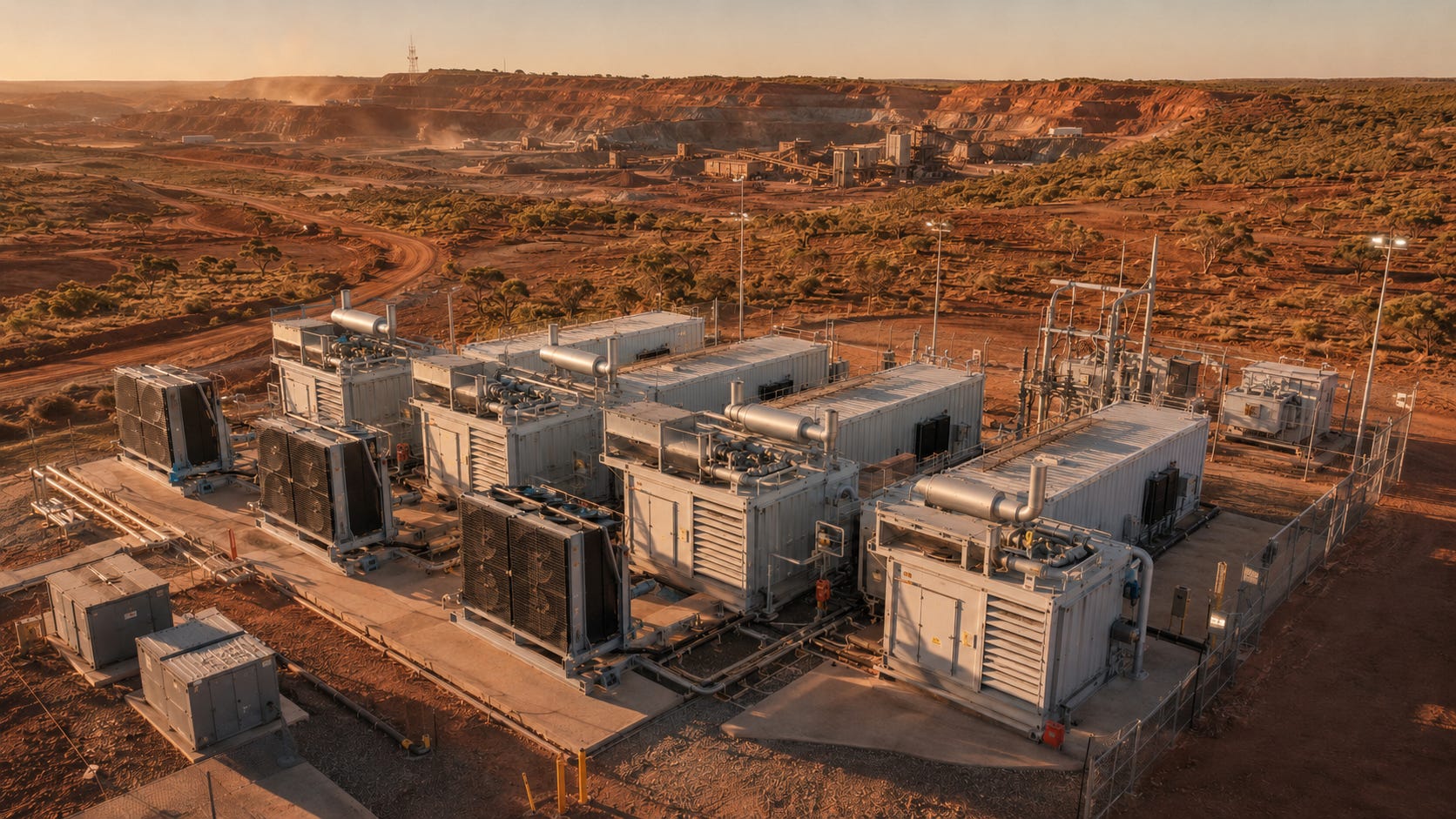
I have spent a lot of my career around power systems in places where the grid was never the default. Remote mining operations in Australia. Industrial operators across Africa. Emerging systems in places like Papua New Guinea. In those environments, resilience was never a design preference. It was the only way the asset ran.
The engineering priorities that fall out of that constraint are consistent:
Uptime treated as a commercial input, not a technical target
Modular capacity that can be added in stages rather than in one build
Fuel logistics and maintainability weighted as heavily as efficiency
Hybrid configurations, because heavy continuous loads and intermittent renewable output do not match without firm generation in the system
Infrastructure designed to evolve, because nothing gets replaced wholesale
Read that list again with a 500 megawatt AI campus in mind. It is the same list.
Reliability is decentralizing
The more consequential shift is not technical. It is about who owns reliability.
Utilities used to own it. Businesses consumed electricity and held backup systems for the rare occasion the utility failed. That boundary is dissolving. Hyperscale developers and large industrial operators are now building their own reliability layers out of onsite generation, storage, microgrid controls, thermal integration, and fuel flexibility.
This is not a rejection of the grid. It is a recognition that the grid is becoming one component of operational certainty rather than the whole of it.
That recognition changes the strategic question. It stops being what fuel a facility uses and becomes which parts of its reliability the operator is willing to leave outside its own control. Transition, in practice, is sequenced infrastructure evolution under reliability and speed constraints, not fuel substitution on a schedule.
Why this matters for the next three years
The data center sector is not inventing distributed energy. It is importing a set of assumptions that industrial operators in constrained markets have worked under for decades, and it is importing them at a scale and speed that industry has never had to handle.
The operators who move fastest will be the ones who stop treating onsite generation as a contingency line item and start treating it as part of the asset.
Full piece on the site:
What Remote Infrastructure Teaches Us About Resilience
If you are working on power procurement for a large digital infrastructure project right now, I would be interested to know which of these constraints you are hitting first: interconnection timing, transmission capacity, or equipment lead times.
Five Nines and Fast Power
Making Better Decisions in AI Power Investments